



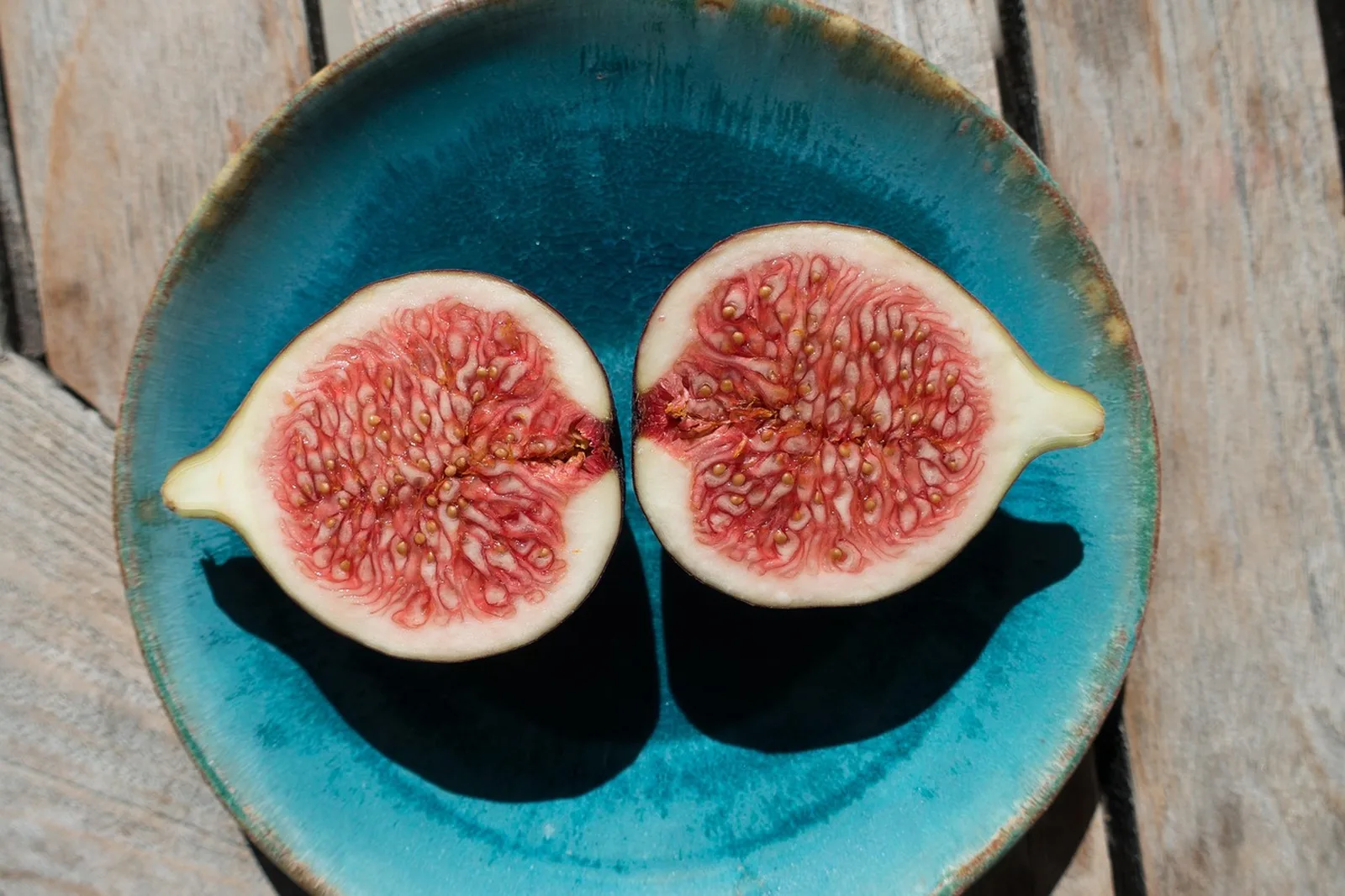
The fig is the first plant named by name in the Bible. Not wheat, not the olive tree, not the vine. A fig tree. Its leaf covers Adam and Eve in the moment they realize they are naked (Genesis 3:7). The fig stands at the passage from paradise to the fallen world. It is witness to the deepest human crisis and at the same time one of the most enduring images of fullness and peace that the Bible knows. Whoever understands this fruit understands a piece of biblical logic.
The first leaf of the Bible
After the bite into the forbidden fruit, the eyes of Adam and Eve are opened. Their first act in the new condition: they sew fig leaves together and cover themselves. No olive leaf, no vine leaf. Fig leaves. This is no botanical coincidence. The fig tree is the oldest cultivated plant of the Near East, attested in the Jordan Valley more than 11,000 years ago. It was there before agriculture, before the first sown barley, before the first planted vine. That its leaf supplies the first clothing of humankind fits the priority of this tree in creation: it was simply already there, large-leaved, pliable, immediately available.
One of the seven kinds
When Moses describes the promised land to the people, he names seven fruits: wheat, barley, wine, fig, pomegranate, olive oil, and honey (Deuteronomy 8:8). Seven, the number of completeness. These seven cover everything a society needs: bread grain, staple food, delight, sweetness, fat, light. Among them the fig is the quick energy: ripe and fresh an instantly available supplier of sugar, dried a keeping store that lasts for months. No milling, no pressing, no treading needed. The fig is the ready meal of creation.
Everyone under his own fig tree
“That everyone may dwell under his vine and under his fig tree” (1 Kings 5:5). “They will sit, each one under his vine and under his fig tree, and no one will make them afraid” (Micah 4:4). The fig tree is more than a source of fruit. It is the biblical image of lived peace. Whoever sits under his own fig tree has safety, property, permanence. The tree needs years before it bears. Whoever plants it reckons with tomorrow and the day after. A people in which everyone sits under his own fig tree is no longer a nomadic people. It has arrived. That this image chooses the fig lies in its combination of shade, yield, and long life: a full-grown fig tree gives shade in the summer heat with its large leaves, bears twice a year, and can grow over a hundred years old.
What is in the fig
No myths, no promises. What we know about the fig is thousands of years old and can be traced with the naked eye.
It is rich in fiber. Whoever has ever eaten a fully ripe fig feels it in the bite: the many small seeds, the tender skin, the soft flesh. Together they make a texture that has no equal. Dried figs contain around 10 grams of fiber per 100 grams, more than most other dried fruits.
It brings along minerals that are vital for survival in the desert: potassium (dried, more than fresh bananas, gram for gram), calcium, magnesium, iron. No laboratory invented this composition. The tree draws it from the soil and lays it down in the fruit. Traditionally, dried figs were carried on journeys and campaigns as an emergency ration. Abigail packs 200 fig cakes for David (1 Samuel 25:18). An exhausted Egyptian slave is given a fig cake, and he regains his strength (1 Samuel 30:12). No wonder. Quick carbohydrates and minerals in compact form.
Its natural sweetness comes from fruit sugar and grape sugar, roughly in equal parts. No refined sugar, no processing. The fig caramelizes by itself in the sun as it dries. What other fruits achieve only through cooking, the fig does through its build alone.
These are observations, not therapy. The Bible does not make the fig into medicine. It makes it into food. And as food it has worked for millennia.
Hundreds of seeds in a single fruit
Botanically the fig is no simple fruit body. It is a syconium: an inflorescence turned inward. What we eat is the thickened flower base, in whose interior hundreds of tiny flowers sit. From each one a small seed with its own embryo forms. Every fine kernel you feel while chewing is a potential new fig tree. A single fruit contains several hundred finished seeds.
This is the seed principle from Genesis 1:29 in maximum concentration: God gives seed-bearing plants as food. The fig does not bear one seed per fruit like the date or the olive. It is a multiple of that. What the human eats already contains the next generation, and not only one, but dozens, hundreds. No other fruit of the seven kinds carries so many seeds in a single fruit body. The fig is not only food. It is a stored forest.
Fresh or dried: two fruits, one tree
Fresh, the fig is a brief pleasure. Picked fully ripe from the tree, it keeps at most two days. The skin is so thin that it barely survives transport. Whoever eats fresh figs eats them at the tree or from the market the same day. A fruit that allows no storage, that compels nearness.
Dried, it becomes the opposite: keeping, transportable, energy-dense. The sun draws the water from it, the sugar concentrates, the fruit preserves itself. Pressed into flat cakes (Hebrew “devela”), dried figs were the standard provision in ancient Israel. Fresh and dried: the same fruit, two entirely different functions. The tree gives both.
Creation logic: the fruit that packages itself
The fig is a fruit without a hull to remove, without a skin to peel, without a core to sort out. It is edible from stem to tip, skin included. No peeling work, no waste, no tool needed. A fruit you put straight from the tree into your mouth and that is fully usable. Along with it a tree that grows on barren limestone soils, in rock crevices, on dry walls, that needs little water and no fertilizer. Two harvests a year: early figs in June, main figs in August and September. One tree, two harvests, zero effort besides picking.
The pollination is a wonder of its own: a tiny wasp slips into the flower, pollinates it, and dies inside. The tree and the insect are so tightly interlocked that neither can exist without the other. A system that sustains itself, pollinates itself, packages itself, and stands available to the human without any return. That is creation logic in its purest form.
Wisdom, not law
The Bible commands no one to eat figs. It describes them, uses them as an image, counts them among the blessings of the land. Jesus curses a fig tree that bears no fruit (Mark 11). Not because figs are bad, but because a tree without fruit misses its purpose. The fig is meant to bear. That is what it is made for.
What the Bible offers is no meal plan but a perspective. The fig was in the Garden of Eden. It was on Solomon’s table. It was in David’s provisions. It sat in the image of the prophet Micah as the epitome of a life in peace. All of that without a single commandment prescribing it. No commandment, only a “look.” The fig is no superfood. It is the opposite: a completely ordinary, ancient food that has done for over ten thousand years what it is made for. Perhaps that is the best definition of healthy food: something that has worked so long that it no longer has to be proven.