



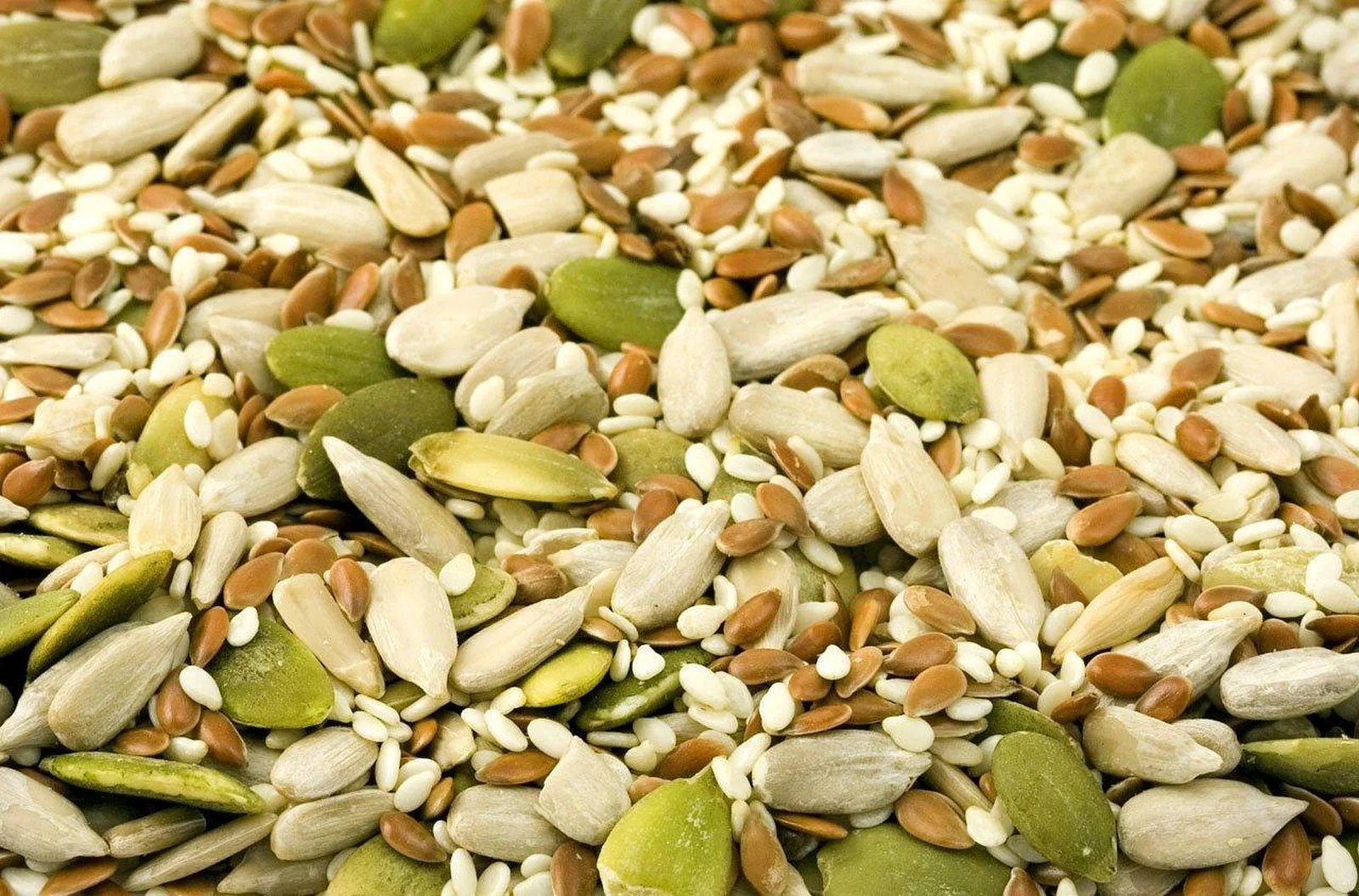
Every seed-bearing fruit carries a compressed wonder. In the seed, often barely visible, sits the complete building program of a new plant: root, stem, leaves, flower, new fruit. Along with it a store of nutrients that supplies the seedling until it can strike its own roots and carry out photosynthesis. Everything a generation needs to start, packed into a few millimeters. That is no biological accident of performance. It is thought-out design with a clear intention: life gives life.
Exactly these seeds God gives to the human as food. In Genesis 1:29 it says: “And God said: See, I have given you every seed-bearing plant on the whole earth and every tree with seed-bearing fruit. They shall serve you as food.” In the same sentence: the plant as food and the seed as a promise for tomorrow. God does not give only the fruit. He lays the germ for the next generation right in with it. Whoever eats an apple eats the seeds along with it, whether he wants to or not. Whoever harvests grain holds the seed in his hand. The original food is seed food. That is no coincidence, but principle.
The logic behind it is simple and deep at once: what is to start new life must bring along everything necessary. A seed that germinates has as yet no access to soil nutrients, no leaf for photosynthesis, no root for water uptake. In the first days it lives entirely from itself. So what the young plant needs must be contained in it: enzymes, vitamins, minerals, fatty acids, proteins, secondary plant compounds. All in concentrated, bioavailable form. This packed density of micronutrients needs no clinical double-blind study to convince. Humankind has lived for millennia on grains, nuts, and legumes. That is the greatest field trial in history. It ran successfully long before there was nutritional science.
Four seeds, four worlds
Let us look at it concretely. Four examples from four plant families. They show how different and yet alike in principle seeds are built.
The grain of cereal: wheat, barley, spelt, oats. Each grain consists of germ, endosperm, and husk. The germ is the living core: it contains the embryo and a package of vitamins (B-complex, E), minerals (zinc, iron, magnesium), enzymes, and unsaturated fatty acids. The endosperm supplies starch as starting energy. The husk (bran) brings fiber and further minerals. That is why whole grain is so much richer than white flour: in the sieving, germ and husk are lost, and with them nearly all the micronutrients. What remains is mainly starch. Creation thought of the grain as a whole.
The nut: walnut, almond, hazelnut. Botanically a single large seed: an embryo embedded in a massive store of nutrients. The nut supplies what the seedling needs for a long start: high-quality fatty acids (the walnut is one of the richest plant sources of omega-3), protein (almonds around 20 percent), vitamin E, B vitamins, magnesium. The hard shell protects for months, until the conditions for germination are right. In nature the nut falls in autumn, overwinters, germinates in spring. The entire energy demand for this dormant phase and the first growth spurt sits in the seed. What carries a young walnut root through the winter has for millennia also carried humans through the winter: stores of nuts. Not a study, but cultural history.
The legume: lentil, chickpea, bean. What we eat is the resting seed, dried and storable. Only with water does life awaken, enzymes become active. Legumes are dense protein packages: lentils around 25 percent, chickpeas around 20 percent protein. Along with it fiber, B vitamins, iron, zinc, folic acid. The lentil was a staple food in Egypt, Mesopotamia, and ancient Israel. The lentil dish for which Esau sold his birthright (Genesis 25) was no arbitrary meal, but a nutrient-dense seed stew. Cooked, seasoned, with bread: a complete meal from the resting life of a seed. Millennia before anyone said “plant protein,” it was a matter of course.
The grape seed: the smallest of the bunch, often spat out. Yet it is exactly in the grape seed that what many buy for expensive money as an extract sits: oligomeric proanthocyanidins (OPC), flavonoids, vitamin E, linoleic acid. The plant equips its seedling with a concentrated protective shell of secondary plant compounds that guard it against UV radiation, fungal attack, and predators. That these protective substances can also benefit the one who eats the seed is no surprise: what protects the germ also benefits the one who consumes it. Traditionally, grape seeds were never wasted. In many cultures they were eaten along with the fruit or pressed into oil, long before a laboratory isolated OPC. Research confirms here what the nose senses while chewing: there is more in it than bitterness.
Why of all things the core is bred out
Here it becomes uncomfortable. If the power sits in the core, one has to ask: why of all things is the core removed? Seedless grapes, degermed refined flour, polished grain: industry preferably takes out exactly the part that creation laid down as a store. More convenient, longer-keeping, cheaper. But emptier.
An example, researched for decades: grape seeds contain OPC (oligomeric proanthocyanidins). The French researcher Jacques Masquelier first isolated this substance in 1948 from the paper-thin brown skin of peanuts, later from grape seeds. OPC is an exceptionally strong antioxidant, in studies around twenty times more effective than vitamin C at intercepting free radicals. And it works together with vitamin C: it protects and renews it in the body. Vitamin and protective substance sit in the same package, just as the fruit grew.
Think of the sailors of earlier centuries and their scurvy, the vitamin C deficiency. The whole fruit with its seed supplies both at once: the vitamin and the substance that carries its effect. That is how it was meant. Whoever breeds out the seeds throws away not the waste, but the powerhouse. No miracle cure, only the whole fruit. Eat the grape, not its isolates. But it is a pattern that runs through all modern food: one removes what God has placed inside, and sells the rest as progress.
Wisdom, not law
We are no longer under the dietary law of the Old Covenant. Jesus made it clear: it is not food that defiles, but the heart (Mark 7:15). Peter was corrected three times when he refused to eat animals shown to him in a vision (Acts 10). Paul writes unmistakably: “Everything God has created is good, and nothing is to be rejected if it is received with thanksgiving” (1 Timothy 4:4). The seed is no commandment. It is an invitation.
It is not about a new set of rules that forbids meat and prescribes grains. It is about looking. Understanding. Deciding for yourself. Creation gives a direction, not a wall. Whoever understands the principle of the seed can choose more consciously at the next shopping: the whole grain instead of the sifted flour, the whole walnut instead of the isolated oil, the sprouted lentil instead of the gray can. No duty. Only a wisdom that has worked for millennia and explains itself at the first bite.
The seed carries what is to grow tomorrow. Whoever eats it eats not only food, but principle. Life that passes life on. More is not needed.