




What nobody tells you about your salad oil
You pour it into the pan every day. It sits in the supermarket under “cooking oils”. It has a green label, often with wheat ears or sunflowers. But the product you are buying there was not food at all for centuries. It was lamp oil. Lubricant for ship engines. An industrial product. And the road from the machine to your plate is less than 50 years old.
Your body is sending signals. Silent inflammation your doctor cannot pin down. A heart that at some point stops playing along. Digestion that never comes to rest. The question is not: which medication takes the symptom away? The question is: what went fundamentally wrong over the last hundred years?
Rapeseed was not food. Rapeseed was a working fluid.
From the 13th century onward, rapeseed oil was burned as lamp oil in northern Europe. It burned brightly, it was cheap, and it was completely unfit for human consumption. In the Second World War it was used as a lubricant for ship engines, because under heat it clings to metal exceptionally well. That was its technical quality: it stuck to hot machines. No engineer would have dreamed of pouring it over a salad.
The reason had a name: erucic acid. Around 40 percent of the oil consisted of this fatty acid, which was linked to heart damage in animal studies.
Only in the 1970s was a new rapeseed bred at the University of Manitoba in Canada. The researchers Downey and Stefansson brought the erucic acid content down below two percent, and in 1978 the result was launched under the brand name Canola: CANadian Oil, Low Acid. A brilliant marketing name. Nobody was supposed to think of lamps or ship engines anymore. Rapeseed was now “cooking oil” because man had made it palatable through breeding, not because it was food by nature.
The invention of the heart attack
In 1911 Crisco came onto the market, the first industrially hardened vegetable fat. The hardening technique it required, hydrogenation, had been developed in 1907: processing liquid oil with hydrogen under high pressure and heat into a spreadable, long-lasting mass. A triumph of food technology. Almost at the same time, in 1912, the American physician James Herrick described the heart attack for the first time as a distinct, survivable clinical condition. Before that, this phenomenon had barely been graspable in clinical terms. Suddenly it had a name and a growing number of patients.
That is not yet proof of cause and effect. But the closeness in time makes you sit up and listen. The body needs decades to build up damage, and the industrial fat revolution began in exactly the generation that turned the heart attack into a widespread disease.
Hexane, heat, deodorization: how your oil is really made
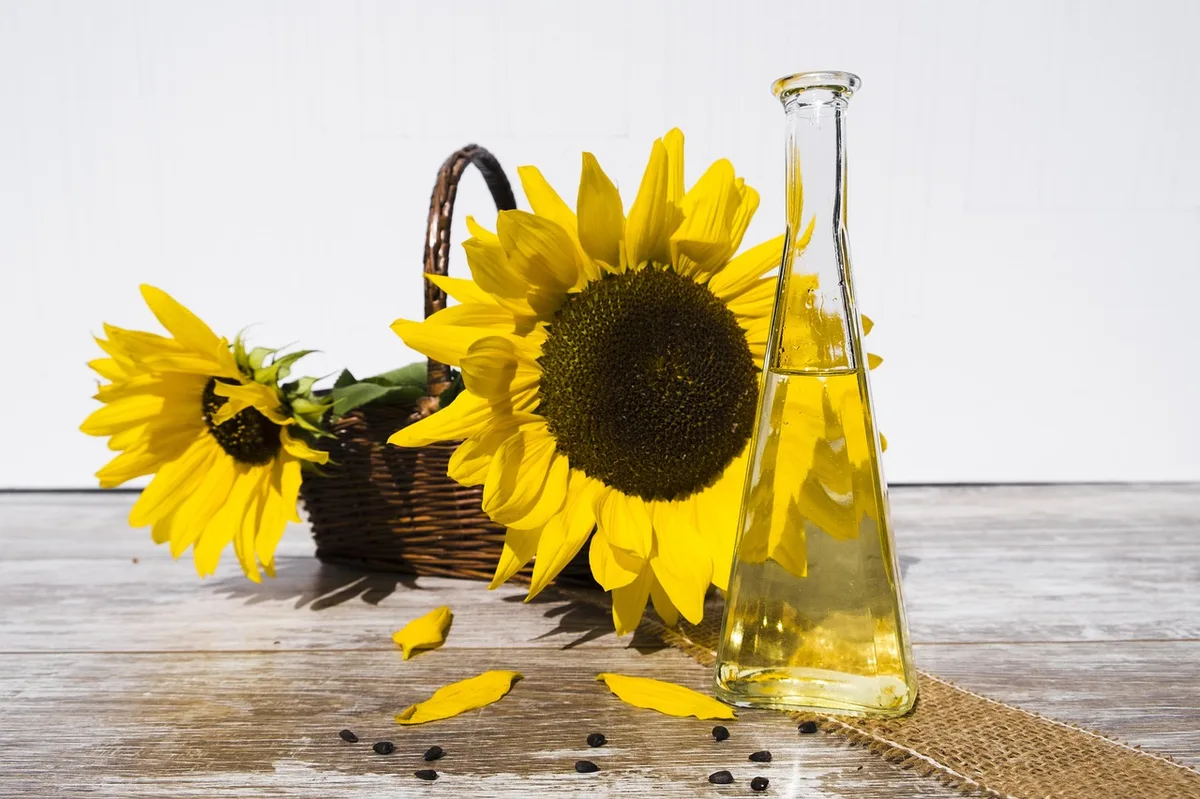
You picture an oil mill. A stone press, slow, cold, purely mechanical. That is the romance being sold on the label. Industrial reality looks different:
- Extraction with hexane. The crushed seeds are washed out with a petrochemical solvent that dissolves the oil out of the cells. Hexane is a by-product of gasoline refining.
- Refining. The crude oil is treated with caustic soda and phosphoric acid to remove cloudy particles and free fatty acids. What comes out smells and tastes of chemicals.
- Bleaching. The oil is filtered through bleaching earth to remove the color. The end product is supposed to look like water, not like something pressed from a seed.
- Deodorization. Under high vacuum and temperatures above 200 degrees Celsius, everything that still smells of the real raw material is removed. The result: an absolutely neutral, colorless, odorless industrial fat.
That is not food. That is the technically processed end product of a chemical production chain. The vitamins and secondary plant compounds that were in the original seed do not survive heat and chemicals. What remains are isolated fatty acids and process residues.
The benchmark: what has worked for thousands of years
This is how olive oil was obtained thousands of years ago: the olives were crushed, the pulp was filled into cloths of woven fibers and pressed for hours until the oil ran into a basin. Purely mechanical, without a single solvent, as excavated oil presses prove. That is the entire difference from the hexane process.
Now set beside that what humanity has been doing since biblical times: olive oil. Cold mechanical pressing. A mill. A stone. Pressure. The oil flows. No hexane, no 200 degrees, no chemical deodorization. The method is four thousand years old, and every generation has passed it on, because it works and because nobody has died from it.
That is the difference between food and an industrial product. Food has a history longer than a patent application. Food needs no marketing name to disguise its origin. Food comes from a process you can understand and watch happening. Industrial products are made in facilities you are not allowed to enter, with an end result that has been deliberately neutralized so it no longer tastes like what it once was.
Not a law, but wisdom
This is not about a new dietary law. The New Covenant is freedom. But freedom is not indifference. Freedom means: I can look, I can understand, and I can decide. Not out of fear, but out of insight. Not out of compulsion, but out of love for the body entrusted to me.
Creation has a built-in logic. Eat what is built as food. Not what was forced into edibility after the fact through breeding, chemical extraction and heat treatment. An apple needs no refining. An olive needs no deodorization. An egg needs no patent application. This simple distinction is not a religion, it is common sense that we unlearned in a hundred years of the industrial age.
Your body speaks to you. Inflammation, exhaustion, metabolic blockages are not enemies to be beaten down with medication. They are signals. Messages. Your body is saying: I do not recognize what you are feeding me. It does not fit my blueprint. Stop fighting the symptom and look at the source.
Back to the truth
Rapeseed oil is not the devil’s brew and canola is not poison. But it is an industrial product with a fifty-year past as cooking oil and a centuries-long past as lamp oil and machine grease. Once you know that, you can shop differently. Olive oil. Coconut fat. Butter from pasture-raised animals. Foods that need no detour through a chemical plant. Foods whose names you understand and whose making you could explain to your child.
The truth sets you free. Not the panic, not the trend, not the next miracle diet. Only honest looking: what is really on my plate? And where did it come from before it landed in the plastic bottle?
Scholarly basis includes: T&T Clark Handbook of Food in the Hebrew Bible and Ancient Israel (Bloomsbury 2022).
Read on: