




Milk is the one food that is truly meant as nourishment. Just for the baby of the species that gives it. Cow’s milk is a growth program for calves. That one plain fact is the honest beginning of every conversation about milk, and it is rarely said out loud.
Milk is a growth signal, not a neutral food
A calf weighs about 40 kilos at birth. Barely a year later it can weigh a few hundred kilos. Its mother’s milk achieves that, and for that purpose it is packed with growth signals: with growth factors, above all IGF-1 (insulin-like growth factor), with hormones and with exactly the right blend of protein and minerals for fast building. Milk is not a neutral white juice. It is a targeted program that makes something grow fast. That is not an accusation, that is biology.
Hormones and IGF-1: what is in it and what it means
Cow’s milk naturally contains cow hormones, above all estrogens and progesterone, and the growth factor IGF-1. Modern dairy cows are usually milked on through pregnancy, so commercial milk carries more of these than the milk of a cow on the pasture once did. And studies show: people who drink milk have higher IGF-1 in their blood.
Now comes the honest assessment, because this is where people often exaggerate, in both directions. IGF-1 is a growth signal. A high IGF-1 level in the upper range is linked in observational studies to an increased risk of some cancers, especially breast and prostate. But an observation is not proof. It is not established that milk causes cancer, the study evidence contradicts itself, and on other questions milk comes out neutral or even favorable. What can fairly be said: permanently feeding an adult body a growth signal made for the rapid growth of a calf deserves a watchful eye. No blind trust and no panic. One more note: the artificial growth hormone rBGH is used in the USA, in the EU it is banned. EU milk therefore contains no added rBGH.
Homogenized and pasteurized: what processing does
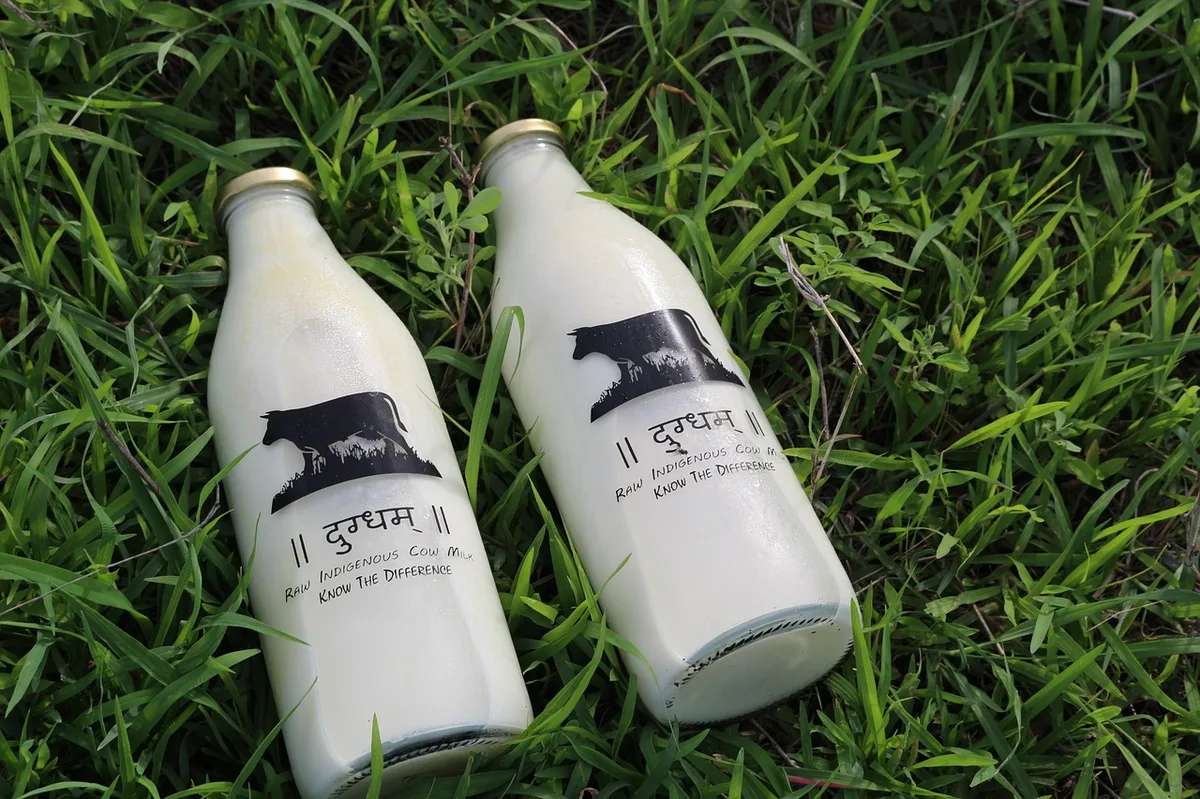
Homogenizing means: the milk is forced under high pressure through tiny nozzles so that the fat globules are smashed so small that the cream never settles out again. That is purely a decision for texture and shelf life, the uniform milk without a cream line. And here we stay honest in the other direction too: the popular claim that homogenized fat thereby passes straight into the blood and damages the arteries is not proven and is largely rejected by research. We are not selling you that. What is true is the plainer thing: a natural structure is mechanically altered, for the shelf, not for you.
Pasteurizing means heating to kill pathogens. That is a real safety gain, milk used to transmit tuberculosis and other diseases. But the heat also kills the beneficial bacteria, deactivates enzymes and lowers some heat sensitive vitamins. You gain safety and lose part of what is alive. Some therefore reach for raw milk. This has to be said honestly and responsibly: raw milk carries a real risk of infection, for example from Listeria, EHEC bacteria or Campylobacter. That can become serious, especially for pregnant women, small children, the elderly and people with weakened immune systems. This is not a decision to take lightly, and in some places it is regulated for exactly that reason.
The body knows: lactose after weaning
The clearest sign that milk is made for the young sits in your own body. Most mammals switch off the enzyme lactase after weaning, because milk was only meant for babyhood. And most humans do the same. Around two thirds of adults worldwide lose most of their lactase after childhood. That is the normal state, not a defect. The ability to digest milk as an adult is a young genetic adaptation, perhaps 10,000 years old, which spread mainly among the dairy farming peoples of Northern Europe, over 95 percent in Scandinavia, while it is rare across much of Asia and Africa. For the largest part of humanity the body itself says: milk was for the time when you were small.
Milk in the Bible: blessing, but food for the young
Milk is consistently positive in the Bible. The promised land flows with milk and honey, an image of abundance and provision. Abraham sets curds and milk before his guests (Genesis 18:8). But notice what the Bible uses milk as an image for: the food of the little ones and the beginners. Paul writes: “I gave you milk to drink, not solid food” (1 Corinthians 3:2). The letter to the Hebrews rebukes those who still need milk instead of solid food (Hebrews 5:12-14). Peter calls new believers to long for milk “like newborn infants” (1 Peter 2:2).
So the biblical image lines up with the biology: milk is the beginning, the food of the young, and growing up means moving on to solid food. And the milk of the Bible came fresh from your own goats and sheep, mostly soured into curds and cheese. Never homogenized, never from a factory.
Research confirms this picture: in ancient Israel it was mainly goats and sheep that gave the milk, and where the Bible names dairy foods, they are cheese, curds and butter, that is, the soured, keepable forms, hardly ever fresh drinking milk. Exactly the path that remains the most digestible to this day.
Wisdom, not law
This is no prohibition and no fear campaign. In the New Covenant no food makes you unclean (Romans 14; 1 Timothy 4:4), and milk is nowhere forbidden. It is an invitation to look clearly. If you use dairy, there are a few wise paths: prefer the soured forms the ancients already knew, that is, yogurt, kefir and aged cheese. They are partly predigested, often better tolerated and closer to the original way. Take as little processed as possible, best from pasture raised animals. And observe honestly whether your own body handles it well, many feel better with less of it. No promise, no guilt. Understand what milk is, and then decide in freedom.
Scholarly basis among others: T&T Clark Handbook of Food in the Hebrew Bible and Ancient Israel (Bloomsbury 2022).
Further reading
Sugar: When Only the Sweetness of the Plant Remains
The Whole Grain: Why White Flour Loses the Germ
The Seed: The Power in the Core