



The gut is the most underestimated organ of the body. Eight meters long, folded and coiled, a surface as large as a tennis court. Up to five hundred million nerve cells. Seventy percent of the immune system sits here. A hundred trillion bacteria, viruses and fungi, together heavier than your brain. And yet we talk about the gut as if it were merely a drainpipe for what is left over.
That is wrong. The gut is the root. What is healthy at the root carries the whole tree. What rots at the root drags everything down with it.
Source instead of symptom
Modern medicine often thinks from the symptom. The head hurts, so we treat the head. The skin itches, so we treat the skin. The joints hurt, so we treat the joints. It is as if, with a plant, one were to varnish the wilting leaves and wonder why the trunk no longer holds.
Creation does not work that way. It works from the root. A healthy soil brings forth a healthy plant. A healthy gut brings forth a healthy human being. The one conditions the other, not the reverse. And that is why the sentence is not exaggerated: gut healthy, human healthy.
The connections are no longer guesses. The gut communicates directly with the brain via the vagus nerve, a thick strand that runs from the belly to the head and sends more signals up than down. The gut wall houses the largest immune organ of the body, which continually learns to distinguish friend from foe. The bacteria in the large intestine produce short-chain fatty acids from what we cannot digest ourselves, substances that dampen inflammation and seal the gut barrier. The system is not without relationships. It is a network in which everything hangs together with everything. And the hub is the gut.
The microbiome: what we know and what we do not know
Here we must be honest. Microbiome research is one of the most exciting disciplines of the last twenty years, but it is still young. We know that the composition of the gut bacteria is connected with health and illness. We know that people with certain diseases have a different microbiome than healthy people. We know that a fiber-rich diet promotes the diversity of the bacteria. That is established.
What we do not know with certainty: which bacterium exactly has which effect. Whether the change in the microbiome is cause or consequence of a disease. Whether probiotic pills from the supermarket accomplish what their packaging implies. The research is at the beginning. Many hypotheses are plausible, which does not yet make them true. What is proven is what has been replicated and mechanistically understood. What is plausible is what points in this direction but still has open questions. The difference counts.
What really nourishes the gut
The basic principles are not complicated. They are as old as nutrition itself and were delivered by creation from the start.
- Fiber: the seed as food for the invisible. Fiber is the part of the plant we cannot digest ourselves. But our gut bacteria can. They ferment fiber into short-chain fatty acids that nourish the gut barrier and dampen inflammation. The best sources are what creation has always held ready as staple food: whole grain, legumes, vegetables, fruit with the skin. The seed itself is the most concentrated nutrient store of the plant. For thousands of years it has fed humanity. It needs no seal of quality (see The Seed: Power in the Kernel).
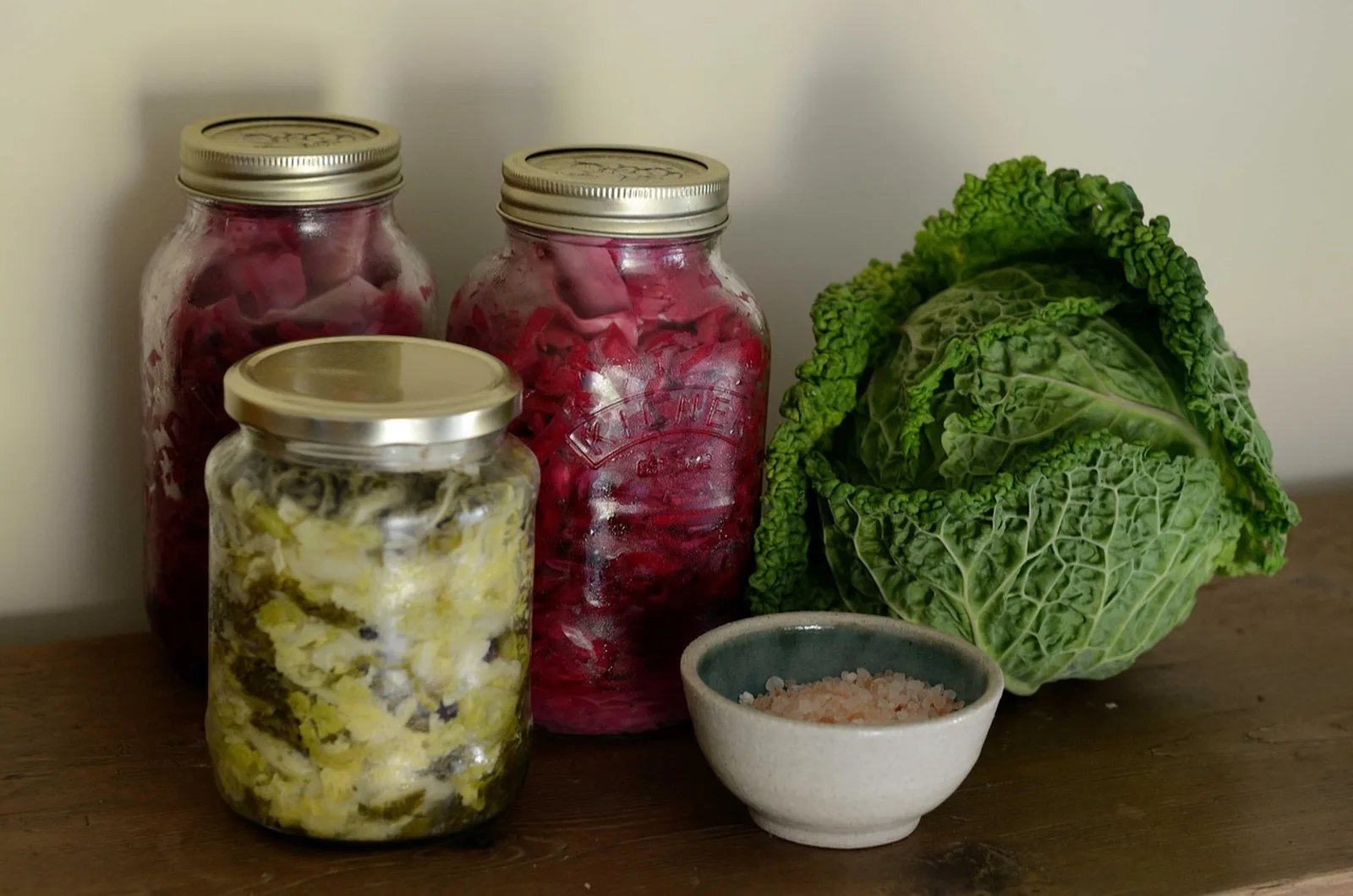
- Fermented foods: time-tested wisdom. Sourdough bread, pickled vegetables, milk ferments. The Bible has known leaven since the second book of Moses. Fermentation was never a trend. It was the original way to make food keep and at the same time enrich it with living microorganisms. Naturally fermented foods contain bacterial strains that can survive the passage through the stomach and reach the gut. They do not replace medicine. But they are one of the oldest and most natural sources of what modern capsules isolate and rebuild.
- Diversity. The more different plants you eat, the more different bacterial strains you feed. Creation knows no monoculture. A field where only one variety grows becomes sick. A gut that gets only a few types of fiber grows poor. Thirty different plant foods per week is a good rule of thumb, and it is achievable with simple means: various vegetables, legumes, nuts, seeds, whole grains.
- Enough water. Water is the transport medium for everything in the body. Without sufficient fluid the gut contents become sluggish, movement slows down, the bacteria get less supply. Creation begins with water (Genesis 1:2). The body consists of about sixty percent of it. Every cell needs it. The gut just as much. It cannot be simpler.
What harms the gut
What harms the soil also harms the gut. That is no coincidence. It is the same logic, only on another level.
- Factory sugar. Isolated sugar does not occur in creation. In the fruit it is always packaged with water, fiber and secondary plant compounds. Isolated and concentrated, it feeds bacteria and yeasts in the upper gut that should not dominate there. The balance tips. The diversity decreases. What the industry sells as quick energy is a burden for the gut it is not equal to, because it was never built for it.
- Ultra-processed products. The further a food is removed from its original state, the less the gut recognizes it. Emulsifiers, preservatives, isolated starches and modified fats are industrial constructs. Studies suggest that certain emulsifiers can attack the protective mucus layer of the gut wall. The research here too is not yet concluded, but the direction is unambiguous: what the body does not know does not do it good.
Creation logic: the gut as a built ecosystem
The gut is not a product of chance. It is a constructed ecosystem that has functioned according to the same principles since the first human: intake, processing, excretion, regeneration. The bacteria that live in us are not intruders. They are part of the blueprint. Without them we could not break down fiber. Without them our immune system would not be trained. Without them the gut wall would not hold tight. Man was never intended to be alone. He was created from the start in community with billions of microorganisms. That is physiological reality. Creation wastes nothing. Every part has a function. Even the invisible one.
What we eat is the signal to this ecosystem. Fiber says: work, divide, stay diverse. Factory sugar says: switch over, multiply uncontrolled. Ultra-processed products say: I do not know you. The gut answers every signal. It cannot do otherwise. It is built to react.
No promises of healing
These principles support a healthy gut function. They are no substitute for medical treatment. If you have chronic digestive complaints, blood in the stool, unexplained weight loss or severe pain: go to the doctor. Have it clarified. No blog post, no dietary principle and no list of foods replaces a diagnosis. Whoever claims otherwise is lying, or selling something.
Freedom, not law
In the Old Covenant there were dietary laws. Clean and unclean. Some things could be eaten, others not. That was a shadow, an image, a preparation for what would come. In the New Covenant everything is clean (Acts 10; Romans 14; 1 Timothy 4:4). There is no more unclean food, no forbidden plate, no compulsion and no guilt.
If you decide to do your gut good, then do it out of wisdom, not out of law. Out of Agape, not out of fear. The Father (Abba) has entrusted this body to you, not as a burden but as a gift. You may care for it, of your own free will, in the knowledge that your acceptance by God does not depend on what lies on your plate. The New Covenant is freedom. Whoever eats less factory sugar does so because he understands and values his body, not because he has to buy merit. Whoever does not is not less loved. Agape and compulsion do not fit together. Agape and wisdom do.
The gut is the root. Healthy root, healthy tree. That is no threat, but an invitation. Back to the source. Back to the blueprint. Back to what has worked from the start. In freedom. In Agape. Without pressure.
Related: