



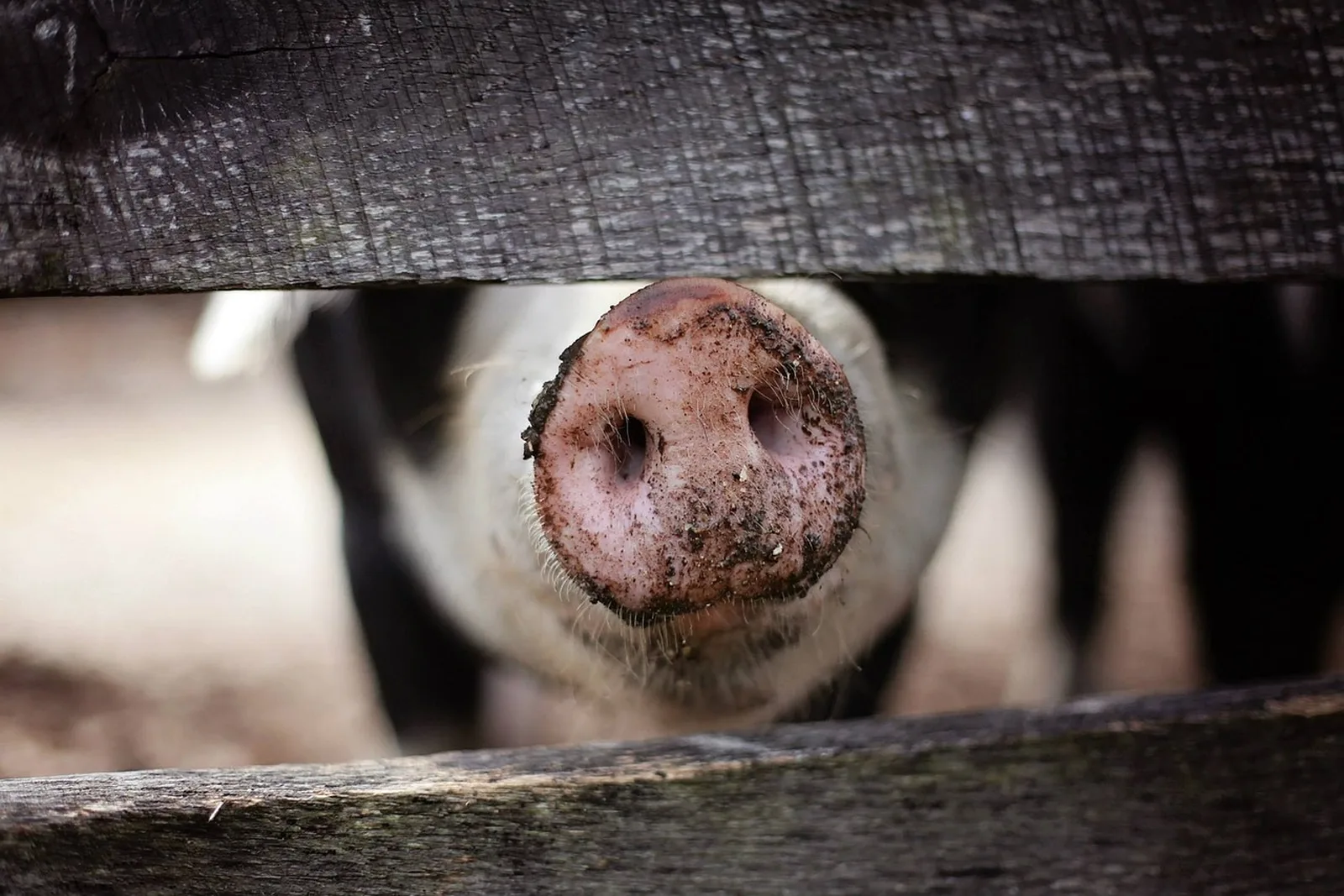
Most people ask the wrong thing about the pig. They ask: “Why is it forbidden?” As if it were about a whim, an arbitrary rule that one follows or does not. The better question is: What is the pig actually made for? For whoever understands this needs no ban anymore. He sees for himself.
An animal that processes everything
The pig is an omnivore in the most literal sense. It eats roots, fallen fruit, waste, carcasses, dung. It uses up what other animals leave standing. A pig makes meat out of garbage. That is no insult, it is an achievement. It is a walking recycling system, built to return leftovers into the cycle.
Whoever has ever kept pigs knows: you can throw almost anything at them, they make something of it. Exactly in this lies their purpose in creation. And exactly in this lies the hint that they are not meant as clean food, but as something else.
Built to survive what kills others
There is an old observation: where pigs live, the snakes disappear. For centuries pigs were also kept to keep farms and lands free of snakes. A pig attacks a snake, and a bite that would kill a human it often shrugs off.
The popular explanation goes: the pig locks the venom in its layer of fat. That sounds good but is not quite true. What science finds is even more remarkable: the domestic pig carries a genetic change to its nerve receptor (the same kind of adaptation as in the honey badger) that prevents the snake’s nerve venom from attaching at all. Added to this is the thick layer of fat as a physical brake. So the pig is no magic animal, and immune it is not: a deep bite can very well kill it. But it is built to shrug off things that kill others.
One only has to say it honestly, as it is. Then the actual insight stands all the more clearly: this animal is a survival and processing specialist. It is made to deal with venom, carrion, and waste. An animal you build to process filth you do not build as a clean meal.
The cleanup crew of creation
And here it becomes big. Creation is not chaos, it is a cycle: it arises, it lives, it passes, it is cleaned up, and out of the cleaned-up new life arises. For this cycle to run, it needs a cleanup crew. Animals whose task it is to clear away death and waste. The vulture over the carcass. The crab on the sea floor. The pig on the ground. And, at the smallest scale, the maggot.
The maggot is the finest example, because man has long since copied it. In hospitals today, sterile maggots are placed on wounds that will not heal, for instance in diabetics. The maggots eat exclusively the dead tissue and do not touch the living, because their digestive secretions dissolve only dead tissue and spare the healthy. They work more cleanly and more precisely than any scalpel, in studies up to eighteen times faster. No surgeon meets this border between dead and living so precisely.
That is no disgusting detail. That is a fingerprint. The maggot is built to the letter to remove the dead and spare the living. Something like that does not arise by chance. That is engineering.
This is why clean and unclean, not arbitrariness
Against this background, the third book of Moses suddenly reads soberly and logically. Clean are the animals built as food: ruminants with split hooves that turn grass, that is, what is unusable for humans, into clean meat. Cattle, sheep, goat. Plant-eaters at the start of the chain. Unclean are those at the end of the chain: the processors, the scavengers, the recyclers. Pig, bird of prey, shellfish.
That is no punishment and no quirk. It is a map of functions. The law only names what is anyway laid down in creation: some things are made to be eaten, some to clean. Israel got it written down as a rule. We may understand it as logic.
Does that need a study?
For much of this no one needs a study. That the seed of a fruit is packed full of nutrients you know not from a laboratory, but because humankind has lived off it for millennia. That is the greatest field trial in history, and it is still running. The logic of creation lies open, readable for anyone who looks.
Where science looks honestly, it confirms it anyway, see the maggot in the hospital, see the receptor of the pig. We gladly quote it when it supports. But we do not make it the supreme judge. For a large part of medicine earns not from the healthy person, but from the sick. A person who understands how he is built and lives accordingly is a bad customer. Whoever waits for a corporation to fund the truth about healthy nutrition waits for Santa Claus. That is no conspiracy, that is simply where the money follows.
Wisdom, not law
And yet: whoever eats pork today does not sin. In the New Covenant it is not food that makes unclean, but the heart (Mark 7:15), and Paul writes that nothing is to be rejected that is received with thanks (1 Timothy 4:4). That stands, and that holds. There is no food that separates you from God.
But freedom is no compulsion to blindness. You may do anything. The question is not whether you may, but whether you want to, once you see what an animal was built for. That is the difference between law and wisdom. The law says: you do not have to. Wisdom asks: have you actually ever looked at the animal?
The decision remains yours. We only supply the look behind it.